

Introduction
Is it worth getting a battery in Melbourne in 2026? It is the single most common question Victorian homeowners ask us right now, and the honest answer is: for many households, yes — but not for all of them. A home battery in Melbourne can be worthwhile when your electricity use, solar generation, battery size and energy tariff line up. When they don’t, you are buying an expensive box that never earns its keep.
Two things changed the maths this year. Feed-in tariffs in Victoria have collapsed to near zero, and the federal battery rebate is now the largest incentive Australian households have ever had for storage. Together, they have pushed solar battery storage in Victoria from “nice idea, terrible investment” into genuinely viable territory for a lot of homes.
This guide walks through the real numbers — battery cost in Melbourne, payback period, rebates, sizing and the situations where a battery still isn’t worth it — so you can work out where your own home lands.
Is It Worth Getting a Battery in Melbourne in 2026? The Short Answer
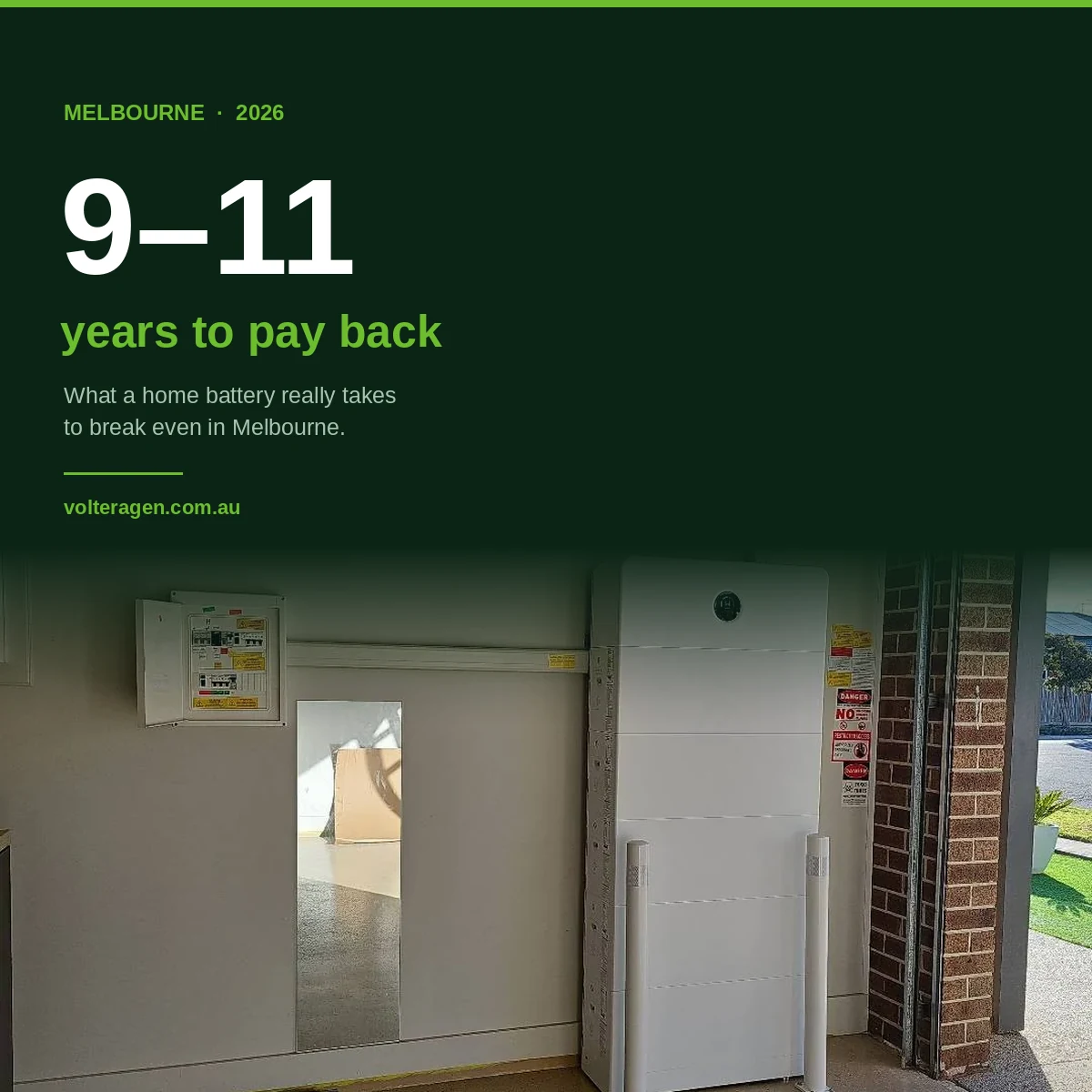
For most Melbourne homes with an existing solar system, a right-sized battery now pays for itself in roughly 8 to 11 years, against a product warranted for 10 years and typically expected to last longer. That is a reasonable-but-not-spectacular return, and it is highly sensitive to your own circumstances.
Whether a home battery system in Melbourne stacks up for you depends on eight factors:
-
- Your existing solar system — a battery has nothing to store without surplus solar
-
- Household electricity consumption — and how much of it lands after sunset
-
- Electricity prices on your current plan
-
- Your solar feed-in tariff — the lower it is, the better a battery looks
-
- Battery size relative to your evening load
-
- Battery installation cost, including any switchboard or inverter work
-
- Evening and overnight usage patterns
-
- Available rebates and incentives
Independent comparison service Solar Choice, which has tracked this question for over a decade, reached a similar conclusion in its national analysis solar batteries are now financially viable in many cases, with typical payback falling from more than 10 years to around 8 years once the federal rebate is applied.
Their video below explains the underlying cost and payback analysis:
Watch: Solar Battery Costs – Are They Worth It?
Why Melbourne Homeowners Are Considering Batteries in 2026
Electricity prices remain the dominant cost
The Essential Services Commission reduced the Victorian Default Offer for 2026–27, cutting the average residential bill by about five per cent from 1 July 2026. That is welcome relief, but it does not change the underlying logic: you still buy grid power at roughly 28–35 cents per kWh, and every kilowatt-hour you avoid buying is worth that full amount.
Exporting solar is now worth almost nothing
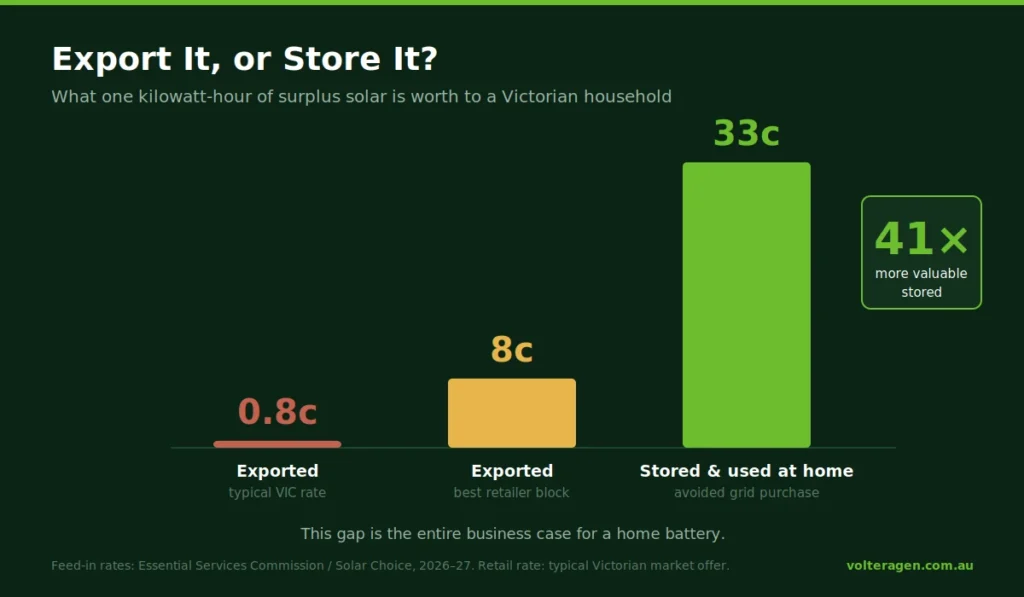
This is the big one. Since 1 July 2025, the ESC no longer sets a minimum feed-in tariff in Victoria. Retailers set their own rates, which cannot fall below zero cents. The average minimum across Victorian retailers for 2026–27 sits at roughly 0.8 cents per kWh, though some retailers advertise up to 8 cents on a first block of daily exports.
The Victorian Government’s own guidance is blunt about the implication: the way to maximise savings from solar is self-consumption, not export. A declining feed in tariff is exactly the condition under which battery economics improve.
Using more of your own solar
A typical solar system without storage covers around 30–50% of household consumption. Add a correctly sized battery and that can rise to 80–90%. That shift in self consumption rate is where nearly all the financial benefit lives.
Backup power and independence
Battery backup during a blackout matters more in some parts of the network than others. Melbourne’s outer growth corridors and the Mornington Peninsula see longer average outages than the inner suburbs. Most modern batteries can keep essential circuits running, though some require additional hardware to do so.
More product choice than ever
The Clean Energy Council’s approved battery list now carries over 1,000 lithium-based models. Competition has pushed pricing down and made residential battery storage in Melbourne a mainstream purchase rather than an early-adopter one.
How Much Can a Battery Save in Melbourne?
The savings mechanism is simple. Your panels generate through the day. Your home uses what it needs. The surplus, instead of being exported for near-nothing, charges the battery. That stored energy then covers your evening and overnight load.
The value of each stored kilowatt-hour is the difference between what you would have paid the grid and what you would have earned exporting it. At a 33 cent retail rate and a 3 cent feed-in tariff, each kWh cycled through the battery is worth about 30 cents.
Savings vary widely between households because three variables move independently:
-
- How much surplus you actually have. A 3 kW system on a home with someone working from home may have almost no surplus to store.
-
- How much you use after dark. Battery savings per year in Victoria depend entirely on evening demand. A household that cooks, heats and runs the dishwasher at 7pm captures far more than one that is out most evenings.
-
- Melbourne’s seasonality. Winter generation drops sharply. A battery that fills every day in January may only half-fill in June.
There is also a second, smaller lever: energy arbitrage. On a time of use tariff, you can charge from cheap off-peak or solar-soak power and discharge during peak. The 2026–27 Victorian Default Offer introduced a three-period structure including an 11am–4pm “solar soak” window with cheaper daytime rates, which makes this more interesting than it used to be.
Melbourne Battery Payback Period in 2026
Payback is the number of years of savings required to recover the installed cost. Advertised payback figures often differ from real-world results because they assume perfect battery utilisation, ignore degradation, or model Sydney and Perth conditions — both of which have better solar resource and higher retail rates than Melbourne.
A realistic Melbourne worked example
Take a common setup: a 5 kW solar array, 18 kWh daily consumption, and a 10 kWh battery retrofitted to an existing system.
| Input | Assumption |
|---|---|
| Melbourne solar yield | ~3.6 kWh per kW per day (annual average) |
| Annual generation | ~6,500 kWh |
| Daily consumption | 18 kWh |
| Usable battery capacity | ~9.5 kWh, ~90% round-trip efficiency |
| Realistic annual throughput | ~2,600–3,000 kWh (accounting for winter shortfall) |
| Net value per stored kWh | ~30c (33c avoided, less 3c forgone export) |
| Estimated annual saving | ~$800–$900 |
Against a 10 kWh battery installed at roughly $8,450 with the federal rebate already applied, that is a solar battery break even point of around 9 to 10 years. Add an inverter/charger for a retrofit onto a system that was never battery-ready and the installed cost rises to about $10,150, stretching payback past 11 years. Factor in energy price inflation of around 3% annually and you claw roughly a year back.
Two things shorten this materially: installing the battery at the same time as a new solar system (avoiding the retrofit inverter cost), and choosing a battery-friendly electricity plan with a premium evening feed-in tariff.
Solar Choice’s national modelling — a 6.6 kW system paired with a 13.5 kWh battery — produced a battery payback period of 7.9 years and a 9% internal rate of return, with the solar portion returning far better than the storage portion. Melbourne sits at the softer end of that national range, which is worth being clear-eyed about.
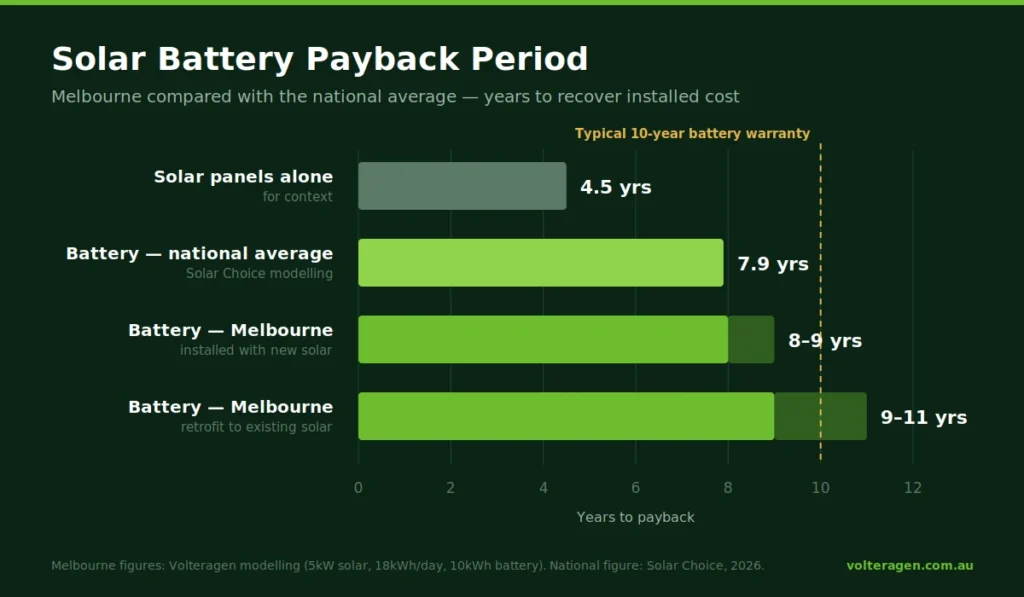
On solar battery lifespan: major brands warrant 10 years, and batteries typically retain 60–80% of nameplate capacity at that point. A battery that pays back in nine years and keeps working for fifteen is a reasonable investment. One that pays back in fourteen is not.
Are Solar Batteries Worth It If You Already Have Solar Panels?
This is the strongest case. If you already have panels, the expensive part — the roof work, the racking, the grid connection — is done. Adding storage only has to justify the storage cost.
Right now, most of your midday surplus is being exported for close to nothing. A battery converts that near-worthless export into electricity you would otherwise have bought at full retail price. That is the whole trade, and at current Victorian feed-in tariffs it is a favourable one.
When adding a battery to existing solar does not make sense:
-
- Your array is small (under about 4 kW) and produces little surplus
-
- You are still on a legacy premium feed-in tariff
-
- Your system has no hybrid inverter and the switchboard needs significant upgrading, pushing installed cost well above market
-
- You already consume most of your generation during the day
A quick diagnostic: look at the export figure on your last four quarterly bills. If you are exporting less than about 8 kWh per day on average, a battery has limited raw material to work with.
Is a Battery Worth It Without Solar Panels?
You can absolutely install a battery-only system, and you can charge it from the grid. The federal rebate does not require you to have solar. But the economics are different and considerably tighter.
Without panels, your battery earns money purely through tariff arbitrage — buying at off-peak or solar-soak rates and discharging at peak. That spread is currently in the order of 15–20 cents per kWh on a well-chosen time of use plan, versus the roughly 30 cents a solar-charged battery captures.
Our recommendation: if you do not have solar, install solar first. The panels return roughly three times better than the storage does, and they also create the surplus that makes the battery worthwhile. If you must do one thing this year, do the panels.
The exception is a household with genuine backup requirements — medical equipment, a home business, an area with frequent outages — where reliability, not payback, is the point.
What Size Battery Do You Need in Melbourne?
| Battery Size | Typically Suits |
|---|---|
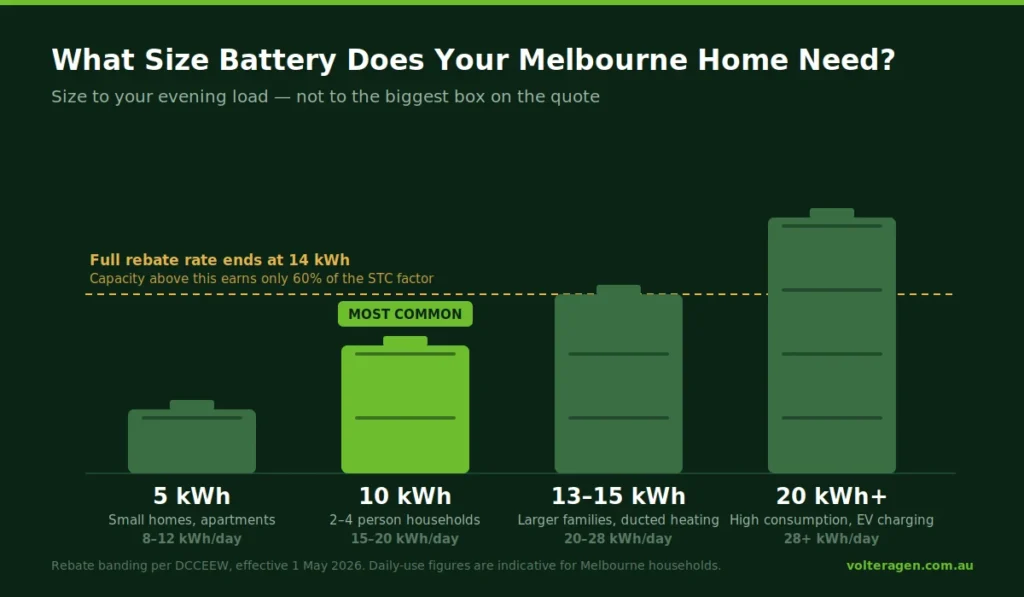
| 5 kWh | Small households, apartments, minimal evening load, backup-only priority |
| 10 kWh | The most common choice — 2–4 person homes, 15–20 kWh daily use |
| 13–15 kWh | Larger families, electric hot water, ducted heating, EV charging |
| 20 kWh+ | High-consumption homes, but check the rebate taper first |
Battery size should be driven by:
-
- Daily electricity consumption (check your bill, not your instinct)
-
- Solar system size — as a rule, you want enough panels to fill the battery on at least 80% of days
-
- Evening and overnight usage
-
- Backup requirements
-
- Household size
The single most common mistake is oversizing. A battery that only cycles half its capacity earns half the return but costs full price. Since May 2026 the rebate structure actively penalises oversizing, which makes right-sizing a financial decision as well as a technical one.
Victorian Solar Battery Rebates and Incentives in 2026
The federal Cheaper Home Batteries Program
This is the main incentive available to Melbourne households. Administered under the Small-scale Renewable Energy Scheme, the Cheaper Home Batteries Program delivers roughly a 30% discount through Small-scale Technology Certificates. Key points:
-
- Worth approximately $252 per usable kWh after administration costs
-
- Applies to systems from 5 kWh to 100 kWh
-
- Claimed at the point of sale by your installer — it comes off the quote, there is no separate application
-
- The battery must be on the Clean Energy Council approved product list
-
- Available whether the battery is paired with new or existing solar
What changed on 1 May 2026
Amendments to the Renewable Energy (Electricity) Regulations 2001 were finalised on 5 February 2026 and took effect on 1 May 2026. Two changes matter:
-
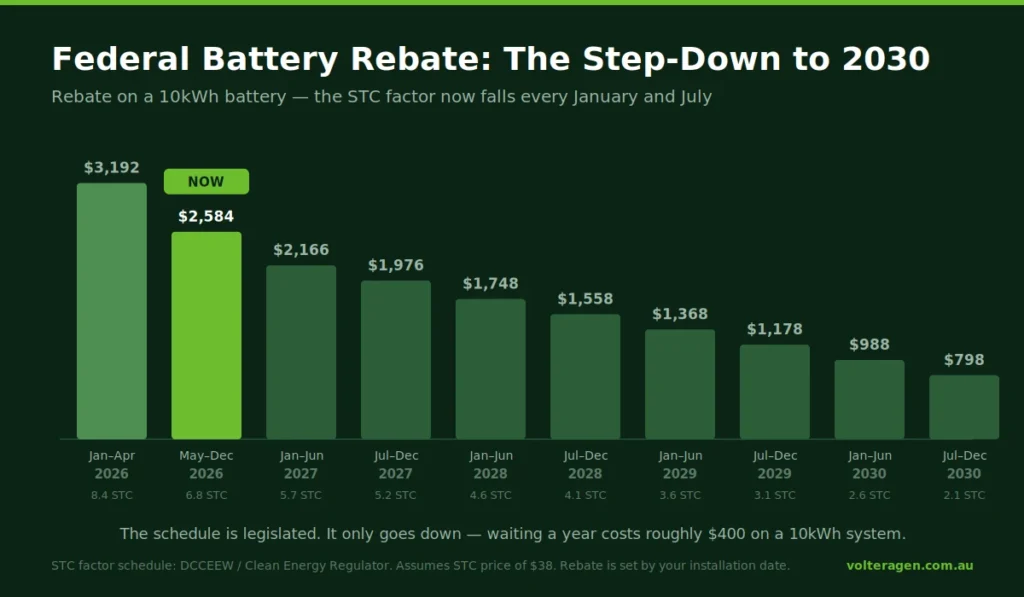
- The STC factor now steps down twice yearly (January and July) rather than annually. It sits at 6.8 for the May–December 2026 window. Your entitlement is locked to your installation date, not your contract date.
-
- The rebate now tapers by capacity. The full rate applies to the first 14 kWh, a reduced rate from 14–28 kWh, and a much smaller rate from 28–50 kWh. Nothing applies beyond 50 kWh.
The practical takeaway: batteries in the 10–14 kWh range now offer the strongest rebate efficiency, and the incentive only shrinks from here. This is a legislated step-down, not a market fluctuation.
Victorian state incentives
Be careful with outdated advice here. Solar Victoria’s interest-free battery loan has closed after reaching its 4,500-loan target, and there is currently no active state-level battery rebate in Victoria. The Victorian Energy Upgrades program has no battery activity either.
Solar Victoria does still offer rebates for solar panels and hot water systems, though the household income cap for those tightened from $210,000 to $150,000 on 1 July 2026.
Disclaimer: Government programs, STC values and eligibility rules change regularly. Confirm current eligibility with your installer and the relevant government body before signing any contract.
see our Solar Victoria rebate guide for the full eligibility breakdown.
Battery vs Feed-in Tariff: Which Is Better?
This comparison used to be genuinely close. It no longer is.
| Export to grid | Store in battery | |
|---|---|---|
| Value per kWh | ~0.8c–8c (retailer dependent) | ~28c–35c (avoided grid purchase) |
| Requires upfront cost | No | Yes |
| Available at night | No | Yes |
| Blackout protection | No | Yes (if configured) |
The entire battery business case is the gap between those two columns. When the minimum feed-in tariff was 11.3 cents, the gap was thin. Now that the average Victorian minimum sits below one cent, storing is worth roughly ten times more than exporting.
One caveat: shop your feed-in tariff regardless. Some retailers pay meaningfully more than others, and a good plan improves your return whether or not you install storage.
Pros and Cons of Installing a Battery in Melbourne
Pros
-
- Higher solar self-consumption — often 80%+ versus 30–50% with panels alone
-
- Materially lower grid electricity usage
-
- Electricity bill reduction with battery storage, particularly for evening-heavy households
-
- Backup power options during outages
-
- Better utilisation of solar you have already paid for
-
- Optional VPP income
Cons
-
- High upfront cost, even after the rebate
-
- Battery degradation over time
-
- Payback period varies widely — and Melbourne is not the best-case city
-
- Not every household needs one
-
- Installation complexity: switchboard upgrades, inverter compatibility, space and clearance requirements
When Is a Battery NOT Worth It?
We would rather tell you this now than after installation. A battery is likely a poor investment if:
-
- Your electricity consumption is very low — under about 10 kWh per day, there simply isn’t enough spend to recover
-
- Your solar system is small and produces minimal surplus
-
- You are on a legacy premium feed-in tariff — exporting may still beat storing
-
- You already use most of your electricity during the day — solar alone is doing the work
-
- The battery is poorly sized for your load, so it rarely cycles fully
-
- Installation cost is unusually high due to switchboard, three-phase or access complications
-
- You plan to sell within a few years — batteries do not reliably return their full cost in resale value
If two or more of these apply to you, wait. The rebate steps down, but so do battery prices, and a bad fit does not improve with a discount.
What Should You Look for When Choosing a Battery?
-
- Usable capacity, not nameplate — this is what the rebate and your savings are calculated on
-
- Product warranty — 10 years is the market standard
-
- Cycle and throughput warranty, and the guaranteed end-of-warranty capacity
-
- Round-trip efficiency — 90%+ is competitive
-
- Backup capability — confirm whether blackout protection is included or costs extra
-
- Inverter compatibility — AC coupled vs DC coupled changes both cost and efficiency
-
- Battery chemistry — LiFePO4 dominates the residential market on safety grounds
-
- VPP compatibility, if you want that option later
-
- Installer experience — CEC accreditation, local track record, and who answers the phone in year six
-
- Australian compliance and local support presence
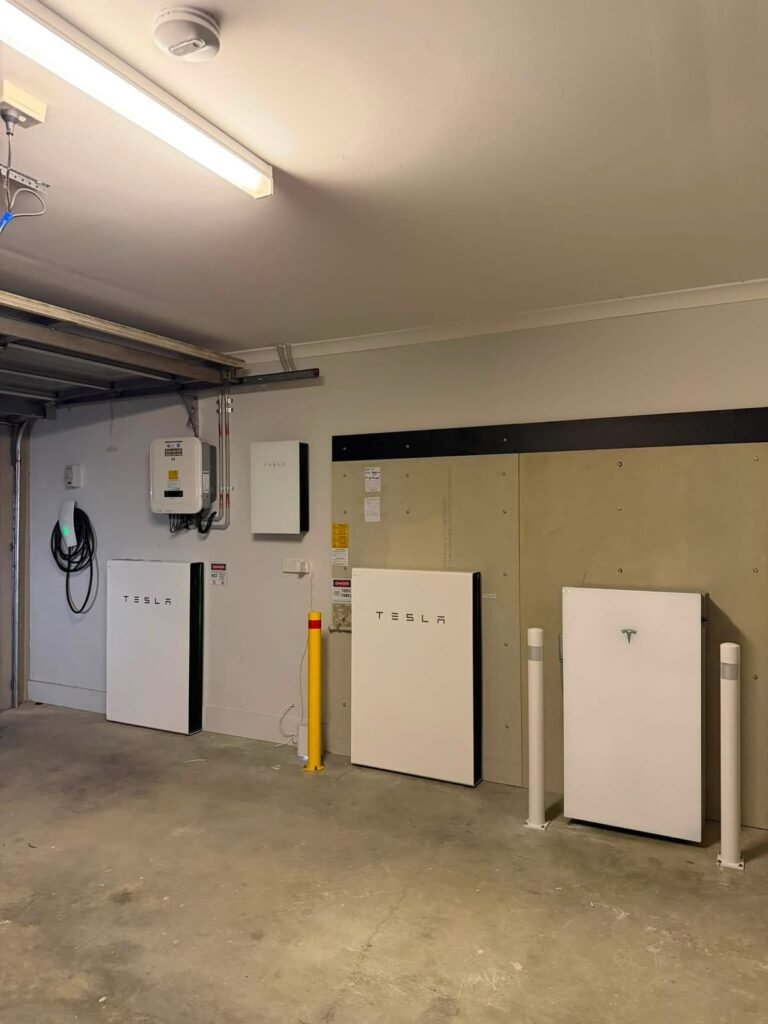
Established options on the CEC list include Tesla Powerwall, Sungrow, BYD, Sigenergy, AlphaESS, Fox ESS, GoodWe, Enphase and Sonnen. There is no universal best solar battery — the right answer depends on your inverter, your capacity requirement and your backup needs.
Battery Cost in Melbourne in 2026
Installed pricing varies with battery capacity, brand, inverter arrangement, installation complexity, switchboard condition and backup requirements. Solar Choice’s national price index puts residential batteries at roughly $550–$1,000 per usable kWh installed, including the federal rebate:
| Battery Size | Battery Only* | Battery + Inverter/Charger** |
|---|---|---|
| 5 kWh | ~$5,325 | ~$7,425 |
| 10 kWh | ~$8,450 | ~$10,150 |
| 15 kWh | ~$11,325 | ~$13,125 |
| 20 kWh | ~$14,300 | ~$16,500 |
* Applies when installing solar and battery together, or retrofitting to an existing hybrid inverter. ** Applies when retrofitting to a system with no battery provision, requiring an additional inverter/charger. Source: Solar Choice Battery Price Index, 2026. Includes the federal rebate; excludes state programs.
Treat any quote well outside these ranges as a prompt for questions rather than an automatic disqualification — genuine site complexity does add cost.
Should You Get a Battery in Melbourne in 2026?
A battery is more likely to be worthwhile if you:
-
- Already have solar, ideally 5 kW or larger
-
- Export significant excess solar each day
-
- Use substantial electricity in the evening and overnight
-
- Are on a low feed-in tariff
-
- Want backup power
-
- Plan to stay in your home for at least five to seven years
You may want to wait if you:
-
- Have very low electricity consumption
-
- Use most of your electricity during daylight hours
-
- Hold a favourable legacy feed-in tariff
-
- Cannot justify the upfront investment without stretching finances
Final Verdict
So — is it worth getting a battery in Melbourne in 2026? For a household with existing solar, meaningful evening consumption and a near-zero feed-in tariff, yes: a right-sized battery in the 10–14 kWh band, installed while the federal rebate is at current levels, is a defensible investment with payback in the eight-to-eleven-year range and useful non-financial benefits alongside it.
For a low-consumption household, a daytime-heavy usage pattern, or a home with a small array, the answer is a straightforward no — and no rebate changes that.
There is no universal yes or no. The only way to know is to run the numbers on your bill: your daily consumption, your export volume, your current tariff and your evening load. That takes about fifteen minutes and it is the difference between a sound decision and an expensive assumption.
Want to know whether a battery is worth it for your Melbourne home? Get a personalised solar and battery assessment.
Frequently Asked Questions
Is it worth getting a battery in Melbourne in 2026? For most Melbourne homes with existing solar and meaningful evening electricity use, yes — payback typically falls between eight and eleven years with the federal rebate applied. It is not worthwhile for low-consumption households, homes with small solar systems, or households on legacy premium feed-in tariffs.
How long does a solar battery take to pay for itself in Melbourne? Around 9–11 years for a typical 10 kWh retrofit, shortening to 8–9 years when installed alongside new solar or paired with a battery-friendly electricity plan. Payback depends on your consumption, tariff, battery utilisation and installed cost.
What is the best battery size for a Melbourne home? Most homes land on 10–13 kWh. Size to your evening and overnight load, and ensure your solar array can fill the battery on at least 80% of days. Since May 2026, capacity beyond 14 kWh attracts a reduced rebate rate.
Are solar batteries worth it if I already have solar panels? Usually yes. Adding storage converts near-worthless exports into electricity you would otherwise buy at full retail. It works less well if your array is under about 4 kW or you already consume most of your generation during the day.
How much does a battery cost in Melbourne in 2026? Roughly $550–$1,000 per usable kWh installed after the federal rebate. A 10 kWh battery typically lands between $8,450 and $10,150 depending on whether an additional inverter/charger is required.
Are there battery rebates in Victoria in 2026? The federal Cheaper Home Batteries Program is the main incentive, worth around $252 per usable kWh and claimed at the point of sale. Solar Victoria’s interest-free battery loan has closed and there is no active state-level battery rebate. Confirm current eligibility before purchasing.
Can a solar battery power my house during a blackout? Only if configured for it. Most modern batteries support backup, but some require additional hardware, and backup is usually limited to selected essential circuits rather than the whole home. Confirm this in writing on your quote.
Should I buy a battery outright or join a VPP? Buying outright gives you full control; a virtual power plant can add income through bonus feed-in rates, annual fees or installation discounts in exchange for the operator dispatching your battery. Read the contract terms on cycle limits and minimum reserve before committing.
What is the best solar battery in Melbourne? There is no single winner. Compare on usable capacity, warranty terms, round-trip efficiency, backup capability, inverter compatibility and installer support — then weigh those against price.